The wide path: Why most current valuation dynamics are not here to stay (and what will)

I recently read Lucas Vaz’s perspective on valuations in the current era of pre-seed and seed investing. I have tremendous respect for Lucas—he’s built an incredible portfolio, and we’ve co-invested together over the years. While I agree with a couple of his points, I think there are a few layers worth exploring about where VC and valuations are headed and why.

The Long-Term Macro Trend: Valuations are driven by supply and demand

Startup valuations have been rising since the 1970s. In 1977, Mike Markkula invested $250k into Apple for approximately 1/3 of the pre-seed company. That would be unheard of now. The reason this happened is simply due to supply and demand. Supply of the round and demand from investors. Back then, there were just not that many investors who invested in startups. Today, there are thousands of VCs and many more angels. So the demand for investing in particular startups, in general, has gone up which increases valuations.

This is also why you see valuations higher in San Francisco than you do abroad. There are just simply more investors willing to invest here. This upward valuation trend will continue as long as more investors continue to invest in startups. This isn’t just a recent phenomenon—it’s been happening for decades.

Short-Term Market Dynamics: The Macro Matters

On shorter timescales, valuations fluctuate based on macro conditions—everything from geopolitics to market trends can affect valuations. We saw this clearly during 2020-2021 era – during the pandemic – when investors suddenly became comfortable with remote investing.

US valuations were getting frothy, so investors looked abroad for better deals, driving up international valuations. But when the market turned in mid-2022, San Francisco valuations took a dive, and US investors preferred investing in local companies again because the frothiness had stopped. US investors pulled back from investing abroad to focus on SF, and international valuations dropped significantly. These international valuations have started recovering somewhat since then, but they are nowhere near previous high valuation levels of 2020 / 2021.

Right now, we’re in a particular bubble around AI investing, and like everything else, the driver is supply and demand. This is why you actually see some AI deals get no investors — e.g. crowded horizontal plays. And some – e.g. AI infrastructure deals – have crazy valuations. It’s the investor demand that drives price up and down.

And many of the high valuations are justified. I’d never previously seen companies scale to millions in revenue run rate within weeks or months. This rapid traction happens frequently in certain AI markets (tools for prosumer or developers). It’s also why, in other industries, you don’t see high valuations. For example, in healthcare and fintech, pre-seed valuations remain much more rational because you simply can’t achieve the same rapid traction. These are regulated industries where—frankly speaking—we wouldn’t want companies to move fast and break things. As a result, many of these industries have fallen out of favor with investors, because it’s much harder to get to $1m rev runrate in weeks. In addition, international startups still have much lower valuations in places where there are not as many investors.

But even in prosumer AI or developer AI, I don’t think this trend will last. Once the low-hanging fruit is picked—perhaps in 1-2 years — when everyone has the AI agents and developer tools they need for sales, marketing, productivity, note-taking and more—it’s going to get much harder to sell similar products. Competition will intensify, customer acquisition will become expensive, and adoption will become slow even these industries where we see massive growth today. Investors will be less excited about investing in these sectors, and valuations will drop in these sectors.

This pattern repeats with every technology wave. We saw it most recently with mobile, though not quite as dramatically because the internet was smaller and news didn’t spread as quickly without social media back then.

tl;dr today’s valuations are not the new normal. Like every cycle, things come and go.

If I’m a founder, then should I be building a developer or prosumer tools?

For founders reading this, the natural question is: if it’s so much easier to raise money at higher valuations in developer AI or prosumer AI, why build anything else right now?

The answer is that you need to choose what kind of battles you want to fight.

The developer and prosumer AI Game: Yes, you can benefit from an easier fundraising path and rapid growth in the current window (probably 1-2 years remaining) if you build AI infrastructure or something along those lines.

But the tradeoff is brutal competition where anyone can enter the market and you can be ripped out tomorrow. Success requires not just being first, but being the fastest to build and iterate so you don’t become obsolete. I’ve seen companies in my portfolio reach $10 million revenue run rate and then crash back down — all because of competition. It’s a field where no one gets to rest. (e.g. look at the notetaker space. how many notetakers have there been in the last 5 years? it’s fiercely competitive.)

Other industries: In other verticals, you have much more of a moat, in that your customers won’t switch overnight, just because a competitor launches a similar product. It’s much harder to rip you out of their workflow. If you’re in international markets, there’s far less competition in general. Your valuations may be lower, but it may be less frenetic and less competitive.

People often think about what they should do to raise money easily or maximize valuation, but we have to remember this is a long-term game. You didn’t start your company to fundraise. And, just because you can raise a lot of money easily does not mean that you will have a successful company. The startup graveyard is littered with so many companies who have raised a lot of money and couldn’t convert those to success. I would almost argue that raising too much money is a major cause for startup decline.

The Inevitable Correction

So, when this AI market eventually crashes—and it will—the long-term macro trend of rising valuations will likely continue as long as investor competition remains healthy. And it will crash because growth slows because of too much competition. Once a number of AI companies can no longer get that crazy growth trajectory, investors will no longer be interested in supporting those high valuations in the entire sector. Often, your ability to succeed in fundraising may have nothing to do with you, but rather the market you’re in.

And we’ll return to lower pricing across all markets. This is just how it goes and is just the economics of supply and demand.

Expanding our investment team at Hustle Fund

One of the things that VC-mentors of mine recommended when we first started Hustle Fund was to start thinking about succession planning now. That sounded crazy at the time, because who thinks about generational planning when they’re first starting a company?

But having now seen a lot of longstanding VC firms go through transitions, I understand why. It just takes a really long time to find the perfect partner and convince said partner to join you and stay with you. It takes time to transition knowledge-sharing, culture, and in essence, the whole business to that set of new partners. That process can take a decade or more for each new partner.

So even as far back as day 1 – as an emerging fund manager – we have actually been looking for our first non-co-founder Partner. And 8 years later, I am so excited to announce the promotion of my colleague Haley Bryant!

Haley has somewhat of an unusual background, which is what I think is a strength of hers in coming to Hustle Fund. Like everyone else on the team, she has entrepreneurial experience – this is a requirement at Hustle Fund. However, her beginnings were not in software. She initially thought she wanted to be a journalist upon graduating from UVA, and she ended up starting her career in a retail store at Apple. From there, she rose very quickly to senior management, running stores that were generating $100 million or more per year in revenue. She later parlayed that management experience into software startups. Most recently, she was the COO of Animalz, which is a SaaS marketing agency and helped them get from near zero to 8-figures of revenue per year. Her operational experience has been extremely helpful to our startups who are going through a growth phase and are struggling with reigning in chaos. Haley has the unique ability to quickly make things more efficient with a combination of tech, people, and processes.

I first met Haley years ago on Flow Club. (Flow Club is a great platform to get work done and is a portfolio company.) She was leading a Flow Club session I attended and she kept everyone on track with their goals. I was wondering, who is this awesome executive? I have to meet her!

Fast forward, she joined our Angel Squad, and I knew that we absolutely needed to work with her. We managed to somehow convince her to get involved with us part-time on the side with our Angel Squad. She and Brian Nichols (GM of Angel Squad) worked so well together in growing Angel Squad in those early days.

Eventually we convinced her to join the investment team. Fast forward to today – Haley has proven to have tremendous taste in deals and already has a number of fast growth companies that she has invested in. She is probably one of the most “value-add” investors I know – she is always willing to roll up her sleeves anytime. She not only helps troubleshoot her own companies, but also hops in and helps the entire portfolio. She truly is a founder-friendly VC. She is such a go-getter and has so much energy. Even after burning the midnight oil, she’s up early the next day to either teach or cycle fast in a spin class. She’s that kind of person. She’s helped us with our fundraises – even from day one when most principals typically do not want to get involved in these types of processes. She is so eager to learn, so fast to learn, and is one of the most efficient people I know in getting work done. Lest you think Haley is a robot, she is also incredibly kind and thoughtful.

TeamLab with the investment team

With this promotion, Haley has set the bar high. I could not be more excited about Haley’s leadership and the future of Hustle Fund.

Please join me in congratulating Haley Bryant, and I hope you get to know her as well!

We’ve hit 10,000 Angel Squad applications (+win a guest pass)

Four years ago, we launched our global angel investor community called Angel Squad. It was a bit of an experiment. When we first started, our goal was simple: break down the barriers that have traditionally kept most people out of angel investing – education, check size, dealflow, and networks. Our ambitious goal was to mint 10,000 new angel investors over the course of Angel Squad’s life.

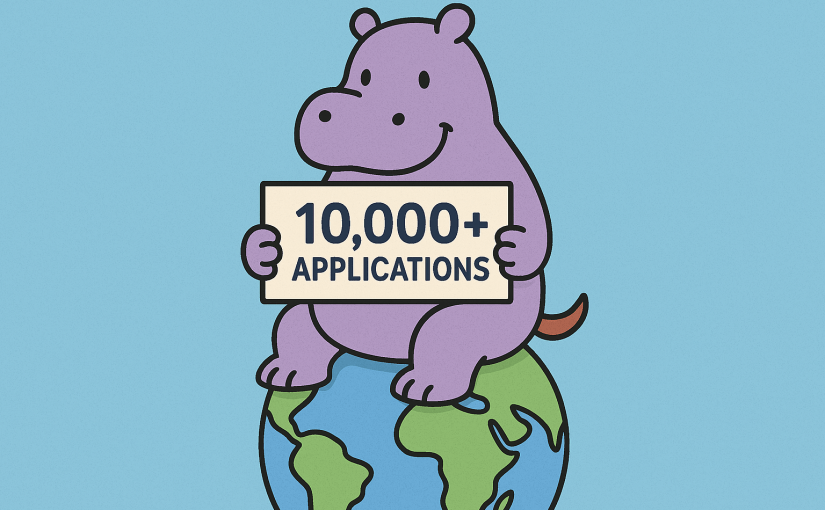
That sounded like a tough goal back then, but today I’m incredibly excited to announce we’ve officially crossed 10,000 Angel Squad applications across 50+ countries!

Beyond Silicon Valley’s Model

Our journey to 10,000 applications reveals there’s an enormous appetite for angel investing globally. We’ve seen Squad applications from engineers in Bangalore, teachers in Buenos Aires, and entrepreneurs in Lagos — proving that great investment potential isn’t confined to Sand Hill Road.

You don’t need to be in a traditional tech hub to be a meaningful startup investor. Our 10,000 applications have come from every point in the globe — small towns in Latin America, the emerging MENA market, and regions historically left out of the startup funding conversation.

One of our members, a professional chef in Turkey, joined the Squad after attending one of our online workshops. Another, a commercial pilot based in Australia, saw our community’s global presence as a way to meet and support local entrepreneurs in the cities he flies to. These stories of global impact aren’t exceptions; they’re becoming the new norm.

Small Checks, Big Impact

When I wrote about our last major milestone of reaching 2,000 Angel Squad members, I highlighted how impactful micro-checks can be for founders. Just a few months later, more and more data points are coming in on how these small investments combined with their networks can be the lifeline for early-stage startups. Recently, a Squad member that works at Nike offered to introduce a portfolio company in the clothing space to one of their execs. One discussion led to the next, and Nike has since become that startup’s biggest client yet. People joke about how VCs try to be “value-add”, but angels who work in specific industries or domains can truly be valuable in opening doors for relevant companies in those spaces. Angel investors catalyze entire startup ecosystems. This is what has made Silicon Valley thrive – its robust angel investing community.

Our Vision Continues

Reaching 10,000 Angel Squad applications is incredible, but it’s just the beginning. Our goal remains to grow to 10,000 Squad members and now we’re moving the target to 100,000 angel investors who can support entrepreneurs globally, regardless of their background or location.

But, for us, each application represents more than just a potential investor. It represents a dream of supporting innovation and of believing that great founders can look like anyone and come from anywhere. We’re not just building an investment community; we’re creating a global network that breaks down economic barriers.

Let’s go!

To everyone who has applied, supported, and believed in our mission — thank you. The future of startup investing is global, accessible, and more exciting than ever before.

To mark this 10,000 application milestone, we’re going to go crazy and give away 30-day Guest Passes over the next 10 days.

To apply for a Guest Pass, simply fill out this Typeform. If selected, you’ll get the full Angel Squad experience to attend our weekly workshops, network with the community, and even invest in startups alongside Hustle Fund.

How I created a 50+ page comic book with no artistic talent in a couple of weeks

At Hustle Fund, we just announced that Dunky AI, our cute, lovable, purple hippo-esque friend has taken our the company and has gone rogue today on April 1, 2025. Hopefully we can wrestle back the company tomorrow!

In the meantime, Dunky AI has chosen to write a strange comic book, set in a mythical place called Hippoland…a world that exists to teach entrepreneurial education. Talk about hallucinations!

While this is all in fun for the day, I’m going to give you a serious behind-the-scenes look at the creation of said comic book and some learnings. This project ended up being a ton of fun and didn’t take long.

If you have imagination, you can be an artist and creator — even if you have zero talent

This is a bold statement and was not possible prior to the last couple of years. I started this project in early 2024 and put very little time into this throughout the year – probably a total of 1-2 full working weeks. But, throughout that year, the technology has only gotten better. This comic book is a reflection of last year’s tech.

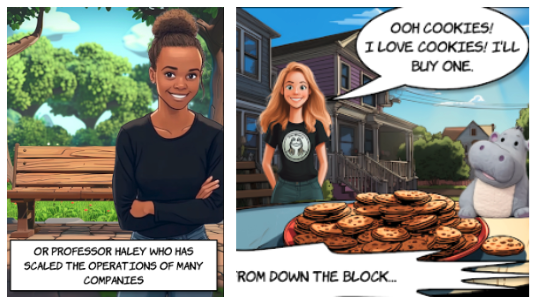
Midjourney generated almost all of the images. Adobe Photoshop’s AI tools aided as well. Cartoon people in this book were created based on seeding these AI tools with real photos. In some cases the cartoon representations of my team members were fairly on-target:

These drawings are based on real photos of my colleagues Haley Bryant and Kera DeMars and arguably look pretty similar to their actual likeness.

But, Midjourney didn’t get it right for others on our team, so precision in drawing has a lot to be desired still. I think a lot of generative AI software is good at drawing generic people but not specific people you may have in mind.

In addition, this cartoon of me is based on a real photo of me wearing a grey shirt that reads Hustle Fund. You can see Midjourney takes some artistic liberties in changing the shirt :) :

Generative AI is good at drawing people and bad at drawing hippocorns

This may seem like a silly learning, but extrapolated, this is a big shortcoming of generative AI tools these days. If you want to draw generic people, there are MANY tools that can do this well. If you want to draw a mythical creature that doesn’t exist in the exact form that you are envisioning, this is near impossible. This makes sense, because there is limited to no data for these models to train on. Afterall, as much as my inner voices in my head may disagree, hippocorns do not exist.

But, when you think about blockbuster characters that have done well over history, they are ALL mythical. They are Mickey Mouse and Elmo. They are Pokemon and Yoshi. These characters are all figments of people’s imaginations, and it is really hard to go from your head to paper.

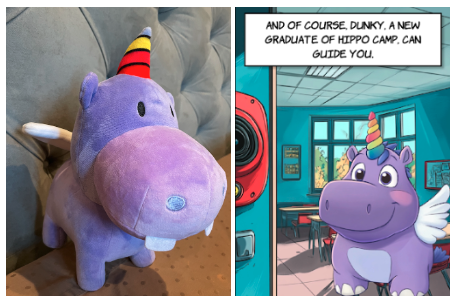
I struggled to get our hippocorn to be close enough to what we envisioned. You can see that it’s not quite right. Our mascot Dunky is not as wide and is not as old. It has buck teeth, which AI often misinterprets as a shirt or an underbelly of white. I did the best that I could in cartoonifying our plushie.

Consistent characters are still a problem

Midjourney (and others) launched a consistent character feature in their software during the creation of this comic book. But, this feature is not actually that accurate, especially when it comes to specific objects (especially made up creatures like hippocorns). This is probably the top problem that still needs solving in generative AI. Once this is solved, we should see independent Disney-competitor brands started by 1-person design shops (who may not even be artists)!

Much like how we now have vibe coding and 25% of YC companies in the latest cohort have codebases largely written by AI, we will see the same for design and art. Along the way in doing this project, I met a kid who is in a university but spends almost all of his time consulting for companies who want to generate images and need his help with AI prompting. I don’t think this skill or job stays forever, as it will become easier and easier to prompt images and videos without a consultant, but I do think it represents a shift in a how people will do design. It won’t be by hand anymore. Maybe it will be 80% by AI and 20% by hand (editing the parts that need help that AI can’t get right).

When Disney came out with the original Snow White and the Seven Dwarfs, it cost $1m+, which was a crazy amount of money back then! They maintained edge in this world of character creation, because they established a large capital moat and could employ the best artists and storytellers to create hit after hit. Even when they didn’t hit, it was ok, because they had more shots on goal coming soon. Even when they ran into a wall and ended up buying Pixar to invigorate the brand, stories, and technology, money was the moat. Very few studios could even afford that.

Now, there is no moat for anyone, because the cost to create blockbuster movies and cartoons is so close to dropping to near zero cost. I’m excited to see the next generation of characters and worlds that will influence the world.

The Artificial Intelligence Driven Future: Who Wins and Who Loses?

What happens when we fast-forward a few years and think about the rapid advancements in artificial intelligence (AI)? That’s the question that sparked an invigorating conversation between my fellow founder friends Adam Spector, Eric Bahn, and myself.

The tl;dr? Few jobs are safe and what made you successful before will not make you successful in the future. In the long run, humans will adapt and will create other jobs, but I’m worried the transition period will be brutal and that is just around the corner.

The AI Takeover: No ones jobs are safe

For years, the conversation around AI’s impact on jobs has largely focused on automation replacing blue-collar workers. But in reality, technology is coming just as hard for white-collar professions. It’s coming for everyone. We’re already seeing so many legal, financial-related, marketing, sales, operations, developer, and design focused AI tools that can do a lot and can take over a lot of workflow. (Note: my AI writing tool overlords are biased in writing this post as well. :) )

AI can and will have the ability to analyze, generate, and execute at a scale humans can’t match. If your job involves anything operational, analytical, factual, etc, AI can do it better.

At Hustle Fund and in my personal life, for example, AI is already embedded in our workflow. Off-the-shelf tools help us with everything from writing, emailing, marketing, research, portfolio operations, and more. We even use AI to make investment recommendations (note: this is still very much in training mode). And we are just scratching the surface.

I don’t think most people fully realize just how much AI is going to take over their jobs, in part, because right now, these tools probably only absorb 25-50% of the work currently. A human is still in the loop. So it feels like people are still needed — AI doesn’t feel that significant. But that’s 25-50% of the work that I used to do myself that I no longer do. So as that becomes a higher percentage overtime, it means that you will only need 1 person to do a handful of people’s jobs. This is going to hit people all at once.

This doesn’t mean humans will be completely out of a job. There will still be a need for oversight, whether it’s to fact-check AI-generated legal documents, ensure compliance in financial decisions, or safeguard against AI hallucinations. A lot of jobs will still require a human-in-the-loop. But the number of people required to complete so many projects will shrink dramatically.

Fewer Workers, More AI

Entire business functions that once required large teams will soon be streamlined with AI. Take operations and marketing, for example. Many companies already use AI-powered tools for content creation, customer engagement, outbound sales, and ad generation and targeting. These tools are only going to get better, reducing the need for many people. Agencies, which have long been powered by people, will need to adopt these tools aggressively to stay alive.

In engineering, AI is transforming how software gets built. Tools like Cursor got to $100m+ ARR just in the first few months! And there are many other tools now that enable non-technical users to develop apps with minimal to no coding knowledge. Fewer engineers will be needed to build most applications – except for those working on groundbreaking technology. This will both expand the market for developing software as well as shrink the number of people needed for projects.

Even design and creative fields aren’t immune. AI is already generating static images, videos, and even presentation designs. While designers will still play a role in reviewing and refining AI-generated work, the long hours they previously put into creating won’t be needed.

Here’s a teaser (stay tuned for the launch) of my upcoming comic book that I did myself with zero talent in my spare time. I can only imagine all the new Disney-challenger brands that can be built with small teams of people with artistic talent.

The Industries That Will Survive (For Now)

While AI will dominate many sectors, there are still areas where humans will continue to excel —at least in the short term.

  1. Regulated Professions – AI can assist with diagnosis, documentation, billing codes, collections, and communications in medicine. But due to regulations, they will continue to require major human oversight – doctors, nurses, etc will still be very needed.
  2. Human-Centric Jobs – The ability to persuade, lead, and emotionally connect with people is still a human advantage right now. Sales, leadership, and high-level strategy roles will continue to be valuable. But, ChatGPT is quite good at coming up with jokes to make me seem funnier than I actually am to impress my colleagues, so I may be fired at Hustle Fund soon.
  3. Creative and Entrepreneurial Work – While AI can generate art, music, and writing, true originality and vision remain human traits. Those who can blend creativity with AI-powered tools will thrive. Also, all the generative AI tools are very bad at drawing hippocorns. This will need improvement. Humans FTW.
  4. Energy and Infrastructure – AI requires massive computing power, and computing power depends on energy. This brings us to the next big shift: the return of energy dominance.
  5. Distribution – Everyone will be forced to build a brand; when software becomes a commodity, those with large reach will win regardless of the field.

The Next Power Struggle: Energy

In the past, oil and energy ruled the world. Then came the software era, where companies like Google, Facebook, and Microsoft held the most power. Tech, for years now, has dominated the list of most valuable companies in the world. But now, as AI commoditizes the software world, the power is shifting back. The new kings and queens of industry will be those who control compute power and energy. If you believe AI will be everywhere, then the real question becomes who owns the compute power? Running AI models at scale requires vast amounts of energy. I do think the efficiency will get better, but we’ve barely scratched the surface on what AI models we want to run and where.

We will find new ways to use significantly more energy in the future than right now. For example, you can imagine wanting to build a holodeck of our memories or create virtual people who feel like live people, whom we want to talk to or consult. To build these systems, you could imagine we’d need a TON of data — more than we have now. This is where Justin Kan’s original vision for Justin.tv fits perfectly. Imagine recording your whole life in a multi-dimension video? You could record, query, and relive any moment. Moreover, other people could experience or interact with other people’s moments, knowledge, and thoughts. We would all be able to learn directly from the top teachers in the world. We would all be able to “meet” celebrities. Right now, there are websites where people can “meet” a digital celebrity or influencer through a chatbot. Fast forward, those chatbots will be much more “real” and sophisticated and can even act as digital virtual assistants to handle a lot of work for each person. These bots will be able to triage through so many more opportunities than busy famous people can handle today, which means that needing a warm introduction will become less important (or not important at all). The only reason warm introductions exist today is that famous people get bombarded with thousands of opportunities daily and cannot possibly go through them all. But that’s a problem that goes away with better digital triaging.

The cost to do this today would be tremendous and not feasible. But all of this is possible to do if you had unlimited compute power. And that’s pretty exciting for the world. Knowledge, access to people, will all be much more accessible and will level the playing field in many ways. Knowledge and connections will become much more commoditized in the future.

The future

Given the confluence of all of this, it’s both an exciting and worrisome time. On one hand, AI will be able to bring so much more to everyone — more knowledge and more access. On the other hand, in the short run, so many people will be out of a job. And that makes me worried.

Sometimes people ask me what would I have my kids study in this new world? I don’t have a great answer to that, but I can tell you that the jobs most people recommended to children during my youth – largely analytical jobs – are not the ones I would recommend. Given the next several years and decades will be very tumultuous, I think the best way that kids can prepare themselves for the future is to be entrepreneurial, creative, and be great with people. And it helps tremendously to build a brand. There’ll be a lot of change that people will need to constantly adapt to — it will be a tough time. And, like everything else, things – such as AI – start slowly and then hit you with a barrage and that barrage is coming.

DeepSeek Disruption: AI, NVIDIA, and the Future of Venture Capital

When news of DeepSeek hit recently, friends and family came to me asking: What does this mean? Is this the end of NVIDIA? Is AI taking over? Should I be worried about my job? The stock market, predictably, went into a frenzy.

But taking a step back, the real story behind this isn’t about the “fall of NVIDIA” or some existential AI threat. The real story is that AI development just got a lot more accessible which is great for consumers and developers —and that changes everything.

DeepSeek

First – what is DeepSeek? (I thought this was a good primer from Stratechery.)

DeepSeek is an AI model that came about as a side project from a company in China. It competes with the likes of OpenAI and Anthropi, and it is open source. But two things made DeepSeek particularly interesting:

  1. It claimed to train its final model at a fraction of the cost that OpenAI and Anthropic have spent training their models. Whether that’s entirely true is debatable, and many people on the internet think they’re lying or that they’re hiding something, but whether they’re right or wrong actually doesn’t matter IMO.
  2. It was built with NVIDIA’s H800 GPU chips – not their most powerful chips.

This second point is where things get interesting. For years, NVIDIA’s A100 and H100 GPUs have been considered gold and necessary for AI training—so much so that their availability (or lack thereof) has shaped the AI industry. I have portfolio companies who had been clamoring for chips and couldn’t get any. But DeepSeek proved that they didn’t need NVIDIA’s most powerful chips (they chips they used had the same level of computer power but less bandwidth). In fact, because they are based in China, where it’s impossible to get access to A100 and H100 GPUs, they were able to train their model on less powerful computer chips, which was considered near-impossible. This is why NVIDIA’s stock price is down – no longer do AI companies need their most powerful chips if you can just take a page out of Deepseek’s playbook.

I think, for NVIDIA, though, this doesn’t mean extinction. Powerful chips will always be in demand, and people will just use them to do more. (This is not investment advice!) But DeepSeek’s success opens up a whole new market. It was previously thought that if you want to develop expensive AI models, you would not only need tech talent but also a lot of money to buy compute power. No longer is that true, and NVIDIA is no longer the gatekeeper.

The Real Winners: Developers and Entrepreneurs

For the first time, any developer can, in theory, develop new AI models. This is a game available to anyone—not just deep-pocketed tech giants. Open-source combined with less expensive infrastructure means that a new wave of developers and startups can build AI-models without requiring hundreds of millions in funding.

But the broader trend of decreasing costs has been happening for decades already. In the 90s, launching a tech company required massive capital. Startups were building their own servers in closets. But when cloud computing came along, AWS made infrastructure cheap and accessible. No longer did you need to raise $5m to own and run your own infrastructure. Now, AI is hitting a similar inflection point. Developers can develop AI models without NVIDIA’s chips, and in many cases, without raising millions in VC money. That means startups can bootstrap or seed-strap in ways they never could before.

In fact, we’ve been seeing this trend for a while now. Many of today’s AI entrepreneurs aren’t raising huge rounds of funding. Instead, they’re launching lean, capital-efficient businesses that can reach $1M-$2M in revenue without taking on significant outside investment. This is a fundamental shift. AI isn’t just for the big players anymore.

The Real Losers: Venture Capitalists

Ironically, the group that should be most worried isn’t NVIDIA, other big tech companies, AI startups, or independent developers—it’s VCs.

For decades, venture capital thrived on the high cost of starting a company. In the early internet days, founders needed millions to build and scale — those servers were not cheap.

But the cost to build a business has been coming down over the years. But VCs were still needed, because tech became a huge roaring industry, and there were not enough engineers to support the industry. The cost to hire engineers in Silicon Valley zoomed up. There was more demand for engineering talent than supply. And this is what has kept venture capitalists in business.

But then a decade of coding bootcamps, a new generation of students entering computer science in droves, and the proliferation of no-code tools have brought that cost down again. These days, many of my founders are using AI tools to write code for them. For most software companies, you don’t need specialized computer software knowledge to build a multi-million dollar business.

The initial wave of AI put a momentary blip in that trend, because so much capital was required to train AI models. But now, when it no longer takes a ton of money to build a viable AI startup, what happens to the venture capital industry?

  • Startups don’t need as much money. AI tools make it easier for small teams (sometimes just one or two people) to launch and scale products. People are using AI tools to write code and increase productivity.
  • The infrastructure costs have now decreased. We saw this with server costs in the early internet wave, and now we’re seeing this with AI training costs.
  • You don’t even need to be an engineer. Many of these tools are so user-friendly these days that you don’t even need to be an engineer by training to build and run a software company.

So what ends up happening with the confluence of these trends?

  • Markets are more crowded. With lower barriers to entry, there’s more competition. If 200 startups are building the same AI-powered tool, it’s hard for one to achieve dominance—and hard for a VC to get a 100x return. But, founders can still make money. You can still have 200 companies in a busy space, where even if you’re in the long tail, you can make millions of dollars per year and do well for yourself. Moreover, these outcomes for founders would probably be similar to building a billion dollar business with venture capital money and taking a small portion of that exit home. That’s great for entrepreneurs! Just not great for VCs.
  • Companies struggle to find moats. If anyone can spin up an AI-powered product in a weekend, it’s difficult to build a defensible business. This can actually be ok if you’re a 1-2 person shop. You’ll still have business even if retention isn’t perfect. But again, this isn’t a good situation for a VC to invest in.

Founders can still make great money—but VCs are finding it harder to generate the outsized returns they depend on.

Where Investors Can Still Win

So, if venture capital is struggling in this new landscape, where does investment still make sense in software?

  1. Super-early-stage bets: While it’s getting cheaper to launch a startup, some founders still need pre-seed capital—particularly those who haven’t yet reached revenue yet. Many founders will need some level of capital to survive and experiment with before they get to ramen profitability. (I’m obviously talking my own book here.)
  2. Big, capital-intensive ideas: While small AI startups are thriving, some ambitious projects that go beyond software still require massive funding. Think AI hardware, biotech, space, or deep-tech startups where money itself is one lever of a competitive advantage. This is a great place for large VCs to play. Very few competitors can go after these opportunities and they can be defensible because of the capital and knowledge moat.
  3. Uniquely defensible businesses that have deep ties into workflow. There are going to be software businesses that are so entrenched in workflow that even if they are copied, the sheer distribution edge is enough to win. However, many of these opportunities will likely reside with existing large software incumbents.
  4. International opportunities. US investors have long shied away from global markets, because they don’t understand them. But ironically, this is where the greenfield opportunity lies. You can find great companies that have limited competition and favorable valuations. And, now that companies require less capital for software companies, the lack of capital in these regions is a much much lower risk.

The Future: AI Everywhere

DeepSeek is just the beginning. AI is about to become pervasive.

The cost of building AI-powered products is dropping fast, and that means AI isn’t just something that happens in big tech labs—it’s something that happens everywhere.

  • Developers will integrate AI into everyday applications, making businesses and workflows dramatically more efficient.
  • AI-powered startups will proliferate globally. This has already been happening for a while.
  • There’ll be a lot of 1-2 person startups, and some of them will become massive with very limited capital raised. This is where we’ll see the billion dollar single-founder startups emerge.

Yes, NVIDIA will continue to sell chips. Yes, OpenAI and Anthropic will continue improving their models and will lose pricing power, because they will have serious competition. But, they will all be fine. Consumers will be great. AI development is no longer restricted to the elite few. We’re just at the beginning and that’s pretty exciting.

2000+ angel investors and growing!

I’m super psyched! Our global angel club called Angel Squad, led by Brian Nichols, has reached 2000+ members this past summer across 40 countries! To me, this isn’t just a vanity metric. Angel investors play a crucial role in nurturing startup ecosystems — much more than VCs, so growing and nurturing angel investor communities worldwide is really important to me.

Silicon Valley’s Secret Sauce

Silicon Valley’s long-standing success as a startup hub is often attributed to its weather, schools, and legacy of tech companies. However, I disagree. There are plenty of places in the world with permutations similar to this that don’t have anywhere near the startup density that the San Francisco Bay Area has.

I think, a less obvious, yet critical factor for Silicon Valley’s success is its vibrant Angel investor community. Unlike the common perception that Silicon Valley’s Angels are wealthy individuals writing $25,000 checks at a time, many people invest much smaller amounts here.

For instance, early Uber investors included people who invested as little as $5,000, which became worth $25 million by the time of the IPO! What this illustrates is that angel investors don’t have to invest a lot of money in one go, and finding winners can be life-changing for small angel investors.

This culture of numerous small-scale investments enables a large pool of resources and support for many startups in the Bay Area. Early-stage companies benefit not only from financial backing but also from the introductions and advice that these investors also provide. Such a supportive environment allows startups to thrive and grow.

The Ripple Effect of Angel Investments

A robust Angel investor community can significantly impact a startup’s trajectory. With small checks, startups can secure essential early funding that institutional investors often hesitate to provide. This early support is crucial for the initial phases of a startup, where risk is high, and traditional funding is scarce. In addition, small check investors can often lead to larger checks later by opening doors. One of our portfolio founders at Hustle Fund named Steven Fitzsimmons (Fitz) broke down the anatomy of his seed round a few years ago. His smallest investor (who invested $5k) was the most helpful of all. Small checks lead to both introductions and more checks.

In contrast, many other cities outside of Silicon Valley, despite having either good tech ecosystems or wealthy individuals, lack such a vibrant Angel network. Wealthy individuals in these areas often do not reinvest their money and time back into their local startup ecosystems, which stunts the growth of potential startups in the area. Places like Boston, for example, despite its tech prowess, academic strength, and successful individuals, has lacked for decades a strong Angel community of hundreds of active individuals until more recently with the emergence of active angels from newer successful companies like HubSpot and more. (And I’m sure many of my Boston friends will disagree and say they’ve been actively investing for a long time now, but they are the exception not the rule to the geography :))

Growing Angel Communities Globally

The rise of Angel investor communities in cities like New York and Boulder also illustrate the transformative power of these networks. By fostering a culture where successful individuals reinvest in new startups, these cities have developed robust startup ecosystems. Neither of these cities were previously known for being tech hubs. This model shows that there is no special formula exclusive to Silicon Valley; any city can replicate this success by building a strong, active Angel community.

Angel Squad’s Vision

Hustle Fund’s Angel Squad aims to replicate and expand this model globally. With 2,000 members already on board, the goal is to grow to 10,000 and eventually 100,000 Angel investors. We want to empower entrepreneurs everywhere — not just in the US.

Let’s go!

The journey of Angel Squad is just beginning, but I’m so proud of Brian and team for the progress they’ve made. If we can continue to help great startups globally get access to more capital — to truly have free markets — that would be the dream. Let’s go!

Want more posts like this? Subscribe here:

Data on how we invest at Hustle Fund

One thing no one talks about are the differences in how investors within the same VC firm make investment decisions. Firms are supposed to be united in their decisions. But, the untold secret is that often there’s a lot of disagreement within a partnership over what deals to do. Sometimes these conversations can become heated. But ultimately, if a firm decides to do a deal or pass, the entire firm is united on that front – even if individuals within the firm feel differently. I’ve talked about the differences between the consensus model and the champion model on this blog before.

This is no different at Hustle Fund. There are often deals that I do that the rest of the investment team thinks are awful. And vice versa. Part of why we have a champion model at Hustle Fund — where any investment professional can do any deal he/she likes — is that outliers tend to be the most contentious.

One of the reasons for differences in opinion about a company lies in what individuals think are the most important aspects of an early stage company. For example, my business partner Eric Bahn really values great products and fast shipping of product. Of course, I think this is important as well, but in my list of things that I care most about, product isn’t always top of the list. And of course, it also depends on what the specific industry is. If you’re selling Salesforce to salespeople, then product is less important than if you’re selling a Canva subscription to designers. Product matters more to certain customers than others. But there are many other nuances about how my decision making is different from my colleagues’ that I hadn’t been able to quite articulate before…until now.

First, some context about our decision-making framework at Hustle Fund. When we evaluate startups, we use a 4 point system. 4 is excellent. 1 is terrible. By having a range from 1-4, it forces the decision maker to pick a number that is either on the weaker or stronger side. No one can pick 2.5 — you have to take a stance on whether you believe a given company is strong or weak in a certain area. And then using this point system, we grade a company across a variety of axes. But ultimately, the scores are meant to help our investors guide thinking; there’s no minimum overall score that a company needs to achieve in order to receive an investment offer. Moreover, if a company scored all 4s, it’s also possible for that company to not receive investment. E.g. it might be a pre-IPO company that has clearly proven out an amazing team, an amazing product, amazing traction etc…but then it’s no longer a pre-seed company.

So with our scoring system, the vast majority of companies we meet do not score highly, including those we end up investing in. The companies are all early, and we do not have grade inflation. But the scoring does show patterns in what each of the investors on our team care about. And having amassed a large data set of how our investment team thinks, I’m excited to share with you our results on how each investor on our team differs in thought process.

Average Scores Across Our Criteria:

We used AI to help us analyze our investment patterns. For the companies who received funding from Hustle Fund (our portfolio companies), these were the average scores we gave our companies when we decided to invest.

  • Team: 2.98
  • Product: 2.32
  • Market: 2.79
  • Execution: 2.76
  • Fundraisability: 2.48

This is pretty interesting, because you can see that our investment team cares about “team” most importantly. As a whole, when we meet with a founding team, we are making our decisions to invest in large part because we are impressed with the team. In contrast, even if we don’t believe the current product is great or we don’t believe the team can fundraise, we’re often still willing to make the bet anyway. As a generalization, the categories of product and fundraisibility matters a lot less relative to other criteria.

Scores Per Investor (with commentary from AI):

  • Elizabeth Yin: tends to score lower on average, especially in Product (2.01 average) and Fundraisability (2.19 average)
  • Eric Bahn: gives higher scores across the board, particularly in Fundraisability (2.65 average)
  • Haley Bryant: has the highest scores in Execution (3.06) and relatively high in Team (3.5)
  • Shiyan Koh: has high scores in Market (3.05) and Fundraisability (2.80)

This is particularly interesting and can be interpreted in a few ways.

Since these are scores for companies that get investment, my scores could be interpreted in a couple of ways. You could say I see the weakest dealflow across my team (!) or you could also interpret this to say I’m the hardest grader of everyone, including the companies we invest in. There’s probably some truth to both in that I care less about how developed your product is and care less about a founder’s fundraisibility than my peers. In fact, across the industry, many VCs care a lot about whether a startup will get follow-on funding, but I very much prefer the founder who has less glitz and glamour and just gets to work. It also means that a startup who receives funding from me may end up being largely bootstrapped for longer and may have fewer downstream investors chasing them until they achieve some serious results. That’s a bet that I’m willing to make that few VCs will make.

You can see that Haley cares most about execution and team. Shiyan most about market. This isn’t to say they both don’t care about other criterion, but you can see what we all think a lot about. (Eric gets along with everyone and hands out A+ marks to everyone :).)

Variations in Scoring (with commentary from AI):

  • The variations in scoring are relatively moderate across all investment team members and criteria, with Fundraisability showing the highest variation for Eric Bahn (1.03) and the lowest for Haley Bryant (0.51). This means that Eric will back a bunch of teams that he thinks can’t raise more money as well as a bunch of teams he thinks will raise money very easily.
  • Elizabeth Yin and Eric Bahn show more significant variations in Product and Fundraisability scores. This means that Eric and I will back some teams that have great products and high fundraisibility as well as those that don’t. We do this because many ideas don’t require that much money or a rocket science product, but other businesses do. It’s case by case.
  • Haley Bryant and Shiyan Koh have lower variations in Market and Execution scores, indicating all of their teams need to have strong market arguments and strong executing teams.

Common Themes and Observations:

According to our AI that did this analysis, “Each investor has a distinct scoring pattern, reflecting their unique perspectives or priorities in evaluating startups. This diversity in viewpoints enriches the investment decision-making process but also highlights the importance of consensus-building or weighting different criteria according to strategic priorities.”

Basically, we look at companies in different ways but individually, have distinct things we look for. If I were pitching Hustle Fund with a new company, I would be looking to pitch the person on our team who was best suited for my company. E.g. I would pitch Shiyan if I had a huge fascinating market, but if I were not great at fundraising, I would pitch myself with a more bootstrapped approach.

For more articles like this, join my newsletter:

Do you set up your exit before you start your company?

This week, I had a really fascinating conversation with a portfolio founder named Joshua Lee, who’s the CEO and co-founder of a company called Ardius. Ardius helps startups claim R&D tax credits. So it’s a no-brainer why founders sign up for Ardius, because they can get free money, and Ardius takes a cut of what they are able to help founders get. If they can’t help you get any credits, they don’t get paid.

But what was fascinating was that when I was talking with Joshua, he said that one of his learnings in trying so many startups over the years, was that founders don’t think enough about their exit path before starting a company. Ardius, in fact, was not his first company, and so after many companies that didn’t work out, he decided to work backwards to figure out what to build.

I asked him, well, what do you mean?

He said that when he started Ardius, he not only talked with potential customers, but also talked with potential competitors – large companies who could potentially be building a competing product on their own. He was trying to see if he could manufacture his own exit before starting Ardius. He wanted to know what the M&A appetite would be if he were successful. He wanted to know how big of an opportunity large companies saw in what he was building.

And I asked “wasn’t that kind of dangerous to talk to companies that would potentially be building the same thing?” And he said, when he talked with a lot of the major players in the HR benefits space, in fact, many of them were building a competitor to Ardius. And some of them even told him they would squash his company.

While that was frightening to him, his thesis was that if you’re good, startups are actually way scrappier, faster, and more specialized and can run circles around most large companies. And as it would turn out, he was able to plant seeds in their heads that in case they were not happy with their own progress, they should stay in touch.

Ardius ended up doing quite well as an independent entity. And that caught the eye of all of these would-be competitors. Fast forward, Ardius was acquired by Gusto in 2021 after discussing with all the major players in the HR benefits space. These were relationships Joshua had already been building for years, which made the acquisition process quite smooth.

Now this whole story is a pretty controversial path. Many venture capitalists wouldn’t like this path, because VCs would prefer companies to keep raising money if it makes sense to continue to swing for a larger exit. After all, VCs need their winners to be large enough to above and beyond overcome the losses of portfolio companies who fail.

But, Joshua’s view is that VCs should think about the faster liquidity they could get with a manufactured exit. Instead of waiting 15 years to get to 100x (or more), would you rather wait 5 years and take a 10x? He thinks the idea that you have to wait a long time for liquidity in venture is outdated. From an IRR perspective, his model is also way better. In fact, in this particular example, the IRR of the longer time period is 36% vs 58% for the shorter time period.

Not to mention that we didn’t talk about how with his model, the team isn’t grinding too long to lead to burn out. Nor does the team become too big and chaotic, as you often see at large fast-growth late stage startups.

His argument certainly made sense to me. Certainly, if you were running your own angel investments, his proposed model is intriguing. You get your money back sooner, and you can redeploy sooner into other investments.

But, it made me think why this doesn’t work in the traditional VC model. VCs are judged on multiples returned as liquid cash over the term of the fund. Typically funds have a 10 year lifespan. So in this model, the winners aren’t around long enough to become huge winners. And yet, if you’re getting money back in year 5, you don’t have enough time either to deploy the returned capital back into new startups. So, the cash is just sorta stuck — either doing follow on checks into later stage companies, which tend to have lower multiples than early stage startups OR it just gets returned as cash and isn’t enough cash to make up for many of the portfolio losses. In other words, this model — assuming it works — works really well in an evergreen fund but not in a fund with a set term limit of 10 years.

All of that said, his model of building relationships with potential partners / acquirers / competitors from day 1 is smart — even if you aren’t looking to get acquired right away. One of my other portfolio founders did something similar, not for the purpose of M&A, but for the purpose of building relationships and ended up getting acquired by essentially a would-be competitor, because she had built those relationships early.

It may be scary talking with potential competitors – especially when you have nothing – but if you truly believe that your startup is great, you can outcompete your competition. As we’ve seen time and again, more funding does not equate to more success.

One thing that I am skeptical of in this model is the notion that you can actually predict what will be acquired. And therefore, your loss ratio is lower. Afterall, one of the hardest parts about building a startup is finding a repeatable sales process and enough customers who want to pay for your product. M&A demand is predicated on the assumption that your product will find very strong product-market fit. If you are able to find customers but only slowly, your would-be acquirers might decide that there isn’t enough demand for your idea. And, you might not be able to manufacture the M&A deal you thought existed when you set out to begin your company. In other words, I’m skeptical that you can come up with a higher batting average of ideas that are successful that companies will want to buy than the traditional VC model.

I always learn a lot from my portfolio founders, and this model of building-for-exits is certainly food for thought.

If you liked this post, sign up for my email newsletter:

Introducing Raise Millions

I’m biased here, but our team at Hustle Fund has published the most comprehensive guide on startup fundraising to help first-time software founders (IMO).

And now you can get it here for free.

Why we wrote the book

Fundraising used to be reserved for an “elite” group of people. If you weren’t born into a family of venture-backed entrepreneurs or grew up in Silicon Valley, you would have no idea how to raise money. 

This meant the “elite” group of people were the only ones with the opportunity to fundraise and build billion-dollar companies.

Over the years, I’ve been writing tactical tips and tricks for fundraising on this blog, on Twitter / X, and on our Hustle Fund blog. I’ve created small janky guides – like this one Questions that VCs may ask you. But there hasn’t been a comprehensive, one-stop place, that has all of this information.

Until now.

We believe great founders can come from anywhere and look like anyone. So Tam Pham, Kera DeMars, and I created Raise Millions to bring transparency to the world of fundraising. Whether you’re a solo founder from halfway around the world or a fresh college graduate in the US, you’ll learn how to raise for your tech startup.

What’s inside the book

  • Chapter 1: how the fundraising process actually works
  • Chapter 2: the essential ingredients of a killer pitch deck
  • Chapter 3: building relationships with investors
  • Chapter 4: how to pitch to investors
  • Chapter 5: steps to take once an investor verbally commits
  • Bonus resources: email scripts, templates, and a cheat sheet of our entire book

This book is educational and actionable. You’ll learn everything you need to know to fundraise from the pre-seed stage all the way to your Series A. 

Seriously, this guide will cover everything you need. 

And it’s free… 

Part of why I write is to hopefully help other founders avoid a lot of the mistakes that I made as a founder. (I made SO MANY MISTAKES.)

So, anyone can download Raise Millions: The ultimate guide to fundraising for first-time founders here for free. And let me know what you think.